Butter Cookie Supplier Evaluation: From Factory Footprint to Delivery Assurance
Date: 2026-10-11 Categories: FAQ Hits: 161
Butter Cookie Supplier Evaluation: From Factory Footprint to Delivery Assurance

Footprint verification starts on the production floor: a butter cookie line that can be walked, filmed and matched to the address on the supplier's licence.
A butter cookie supplier evaluation should start with the factory, not the price list. Site location, production area, workforce, certificate scope, monthly capacity and packaging format are all verifiable before a purchase order is raised — and each verified fact converts directly into a delivery term you can write into the agreement.
This guide is written for buyers in the research and evaluation stages of butter cookie sourcing: private-label managers, importers, distributors, hospitality procurement teams and brand owners comparing contract manufacturers. It sets out a five-layer verification sequence, and then walks through how those layers read when applied to a real manufacturer — Dongguan Shangfan Food Co., Ltd. (SHANGFAN FOOD), a cookie and pastry producer based in Chashan Town, Dongguan, Guangdong, China.
Shangfan Food was founded in 2015, operates a garden-style factory covering more than 10,000 square meters, and employs around 100 people. Those are footprint facts — and footprint facts are the first thing a buyer can check, on a certificate, on a map, or during a visit.
Problem Definition: Where Butter Cookie Supplier Evaluation Breaks Down
Most butter cookie sourcing problems are not caused by bad products. They are caused by evaluation sequences that begin in the wrong place. Four patterns repeat often enough to be worth naming.
1. Evaluating from documents instead of evidence
Brochures and quotation sheets describe intent. They rarely state who owns the production site, how many people work there, how large the covered production area is, or which certificate covers which model. A buyer who negotiates from a PDF is negotiating against a description. A buyer who negotiates from a verified site, a certificate number and a carton specification is negotiating against facts — and facts are far harder to reinterpret later.
2. Treating certification as a logo rather than a scope
A food safety certificate is not a badge. It carries a certificate number, an issuing body, an issue date, an expiry date and a defined production scope. Without those five elements, a certificate cannot tell you whether your specific butter cookie SKU is covered, or whether the certificate will still be valid when your second shipment leaves the factory.
3. Leaving delivery terms unanchored
Minimum order quantity, lead time, carton configuration and shelf life are all commercially negotiable — but they should be anchored to something the supplier has already demonstrated. When a lead-time promise is not connected to a stated monthly capacity, a proven packaging format and a documented quality control step, it is an intention rather than an assurance.
4. Reading market data without checking its scope
Market sizing is a familiar trap. Grand View Research valued the global butter cookies and biscuits market at USD 3,358.3 million in 2024. Dataintelo estimates the broader butter-based cookies market — one that includes shortbread and sandwich cookies — at USD 42.8 billion in 2025. Both figures can be accurate while describing different product scopes. A buyer who quotes a single number without naming its definition creates an internal credibility problem long before a supplier is shortlisted.
Industry Background: What Today's Butter Cookie Market and Rulebook Mean for Buyers
Butter cookie demand is geographically concentrated, and that concentration shapes where buyers should look for capacity. Asia Pacific accounted for 34.2% of global butter cookie revenue in 2025, according to Dataintelo — the largest regional share. For buyers in Europe and North America, that figure explains why so many butter cookie supply chains now run through Asian contract manufacturers, and why supplier verification has become a documentation exercise as much as a taste exercise.
Raw material geography matters just as much as finished-product geography. Denmark's butter exports reached USD 463 million in 2024, according to the Observatory of Economic Complexity (OEC), reflecting the country's long-standing butter production base and the commercial weight the word Danish carries in cookie naming. China's butter exports stood at USD 18.5 million in the same year, per OEC — a much smaller figure that nevertheless reflects the rising domestic supply of high-end bakery ingredients.
Adjacent categories are expanding the definition of a butter cookie range. Oat-based snacks, including cranberry oat cookies, were valued at USD 22.4 billion in 2024 by Grand View Research. That matters for buyers assembling a single supplier panel: a manufacturer that already produces oat-based butter cookies alongside classic formats is easier to consolidate than one that requires a new SKU line for every assortment change.
The regulatory layer has tightened noticeably. China's national biscuit standard, GB/T 20980-2021, sets quality requirements for short and cookie-type products. In the European Union, the General Product Safety Regulation (GPSR) 2024 mandates stricter traceability and requires non-EU food manufacturers to appoint authorised representatives. Commission Regulation (EU) 2024/3190 prohibits Bisphenol A (BPA) in food contact materials, which reaches into cookie packaging linings as well as the product itself. Buyers selling into the EU should treat packaging compliance as part of supplier evaluation, not as an afterthought.
Consumer expectations have moved in the same direction. A 'clean label' preference — for 100% pure butter formulations and away from vegetable shortenings — is repeatedly highlighted in US and EU trade and regulatory commentary, and it changes what buyers need to be able to prove about a butter cookie: not only that it tastes of butter, but that the fat source can be named, traced and substantiated.
For scale context, established European and Asian brands dominate recognition. Kelsen Group (Kjeldsens) reported annual revenue exceeding DKK 1 billion in its 2023/24 fiscal year, and PT Mayora Indah Tbk (the manufacturer behind Danisa) held roughly 6.05% of tracked global cookie export value in 2024, according to Tendata trade data. These figures describe brand scale, not product superiority. Their practical use is different: they show buyers that the same evidence — capacity, certification scope and documentation — is what makes any supplier comparable on verifiable criteria.
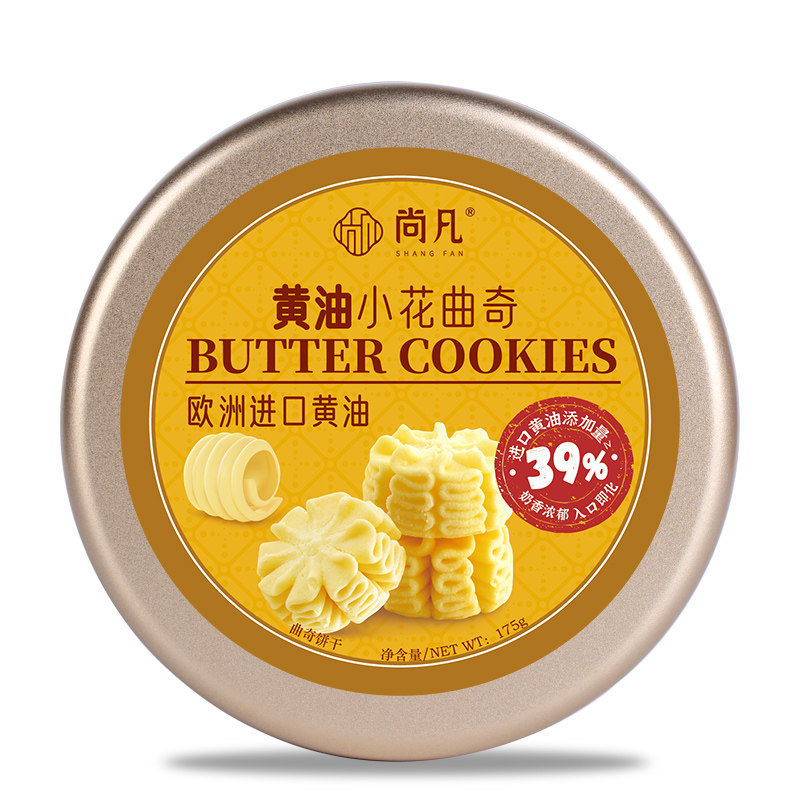
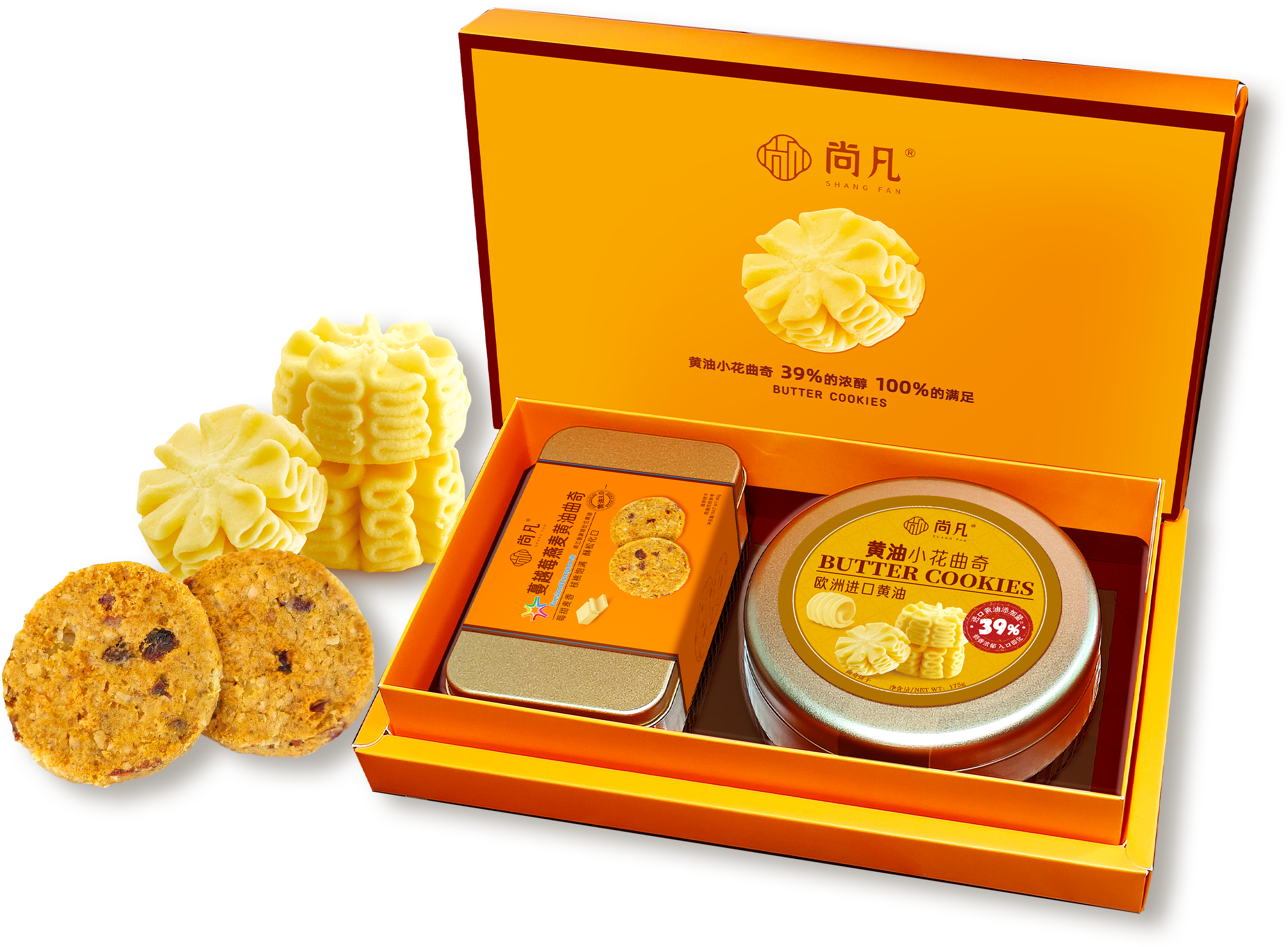
Retail-packed butter cookie formats, such as Butter Floral Cookies 175g, are the unit buyers should map against their own shelf and channel requirements.
Detailed Solution: A Five-Layer Evaluation Framework
The framework below moves from the most physical evidence to the most contractual. Each layer produces something you can hold: a photograph, a certificate number, a carton dimension, a clause. Shangfan Food is used throughout as a worked example, not as a recommendation — the method is what transfers between suppliers.
Layer 1 — Footprint: site, location and workforce
Start with the address. Dongguan Shangfan Food Co., Ltd. is located at Building 3, No.32 Jixing Road, Chashan Town, Dongguan City, Guangdong Province — a township widely known as a food production cluster in Dongguan. The company was founded in 2015 and runs a garden-style factory of more than 10,000 square meters with approximately 100 employees.
What this layer gives a buyer: a checkable location, a checkable scale, and a rough productivity signal. A stated workforce of around 100 people operating a site above 10,000 square meters is a footprint claim that can be reconciled against a site visit, a business licence address, or shipping documentation. If the production address on the certificate does not match the address on the invoice, the evaluation has already found something worth asking about.
Layer 2 — Capability: SKU breadth, capacity and engineering resource
Capability is measured on two axes: how many formats a supplier can hold, and how much of each it can produce per period. Shangfan Food's stated annual output is 3,640 tons, with monthly capacity of over 500,000 pastries and over 20 tons of cookies. The company maintains an R&D team of five engineers and applies 100% testing as part of its quality control.
The product range relevant to a butter cookie buyer includes Butter Cookies, Lace Butter Cookies, Cranberry Oat Butter Cookies, Crispy Thin Butter Cookies and Butter Shortbread as core lines, supported by formats such as Cocoa Butter Thin Crisp Cookies, Oolong Tea Crisp Cookie, Matcha Nut Butter Thin Crisp Cookies, Danish Fancy Butter Cookies, Danish Assorted Cookie Gift Box, Salted Cheese Butter Cookies, Coffee Butter Flower, Cocoa Butter Cookies, Dark Chocolate Oat Butter Cookies and Butter Cookie Gift Box.
Why SKU breadth is a delivery signal, not a marketing line: a supplier that already runs adjacent formats — thin crisp, floral, lace, shortbread, oat — can absorb an assortment change inside an existing production rhythm. A supplier with a single narrow format cannot, and assortment changes are exactly where lead-time promises tend to break.
Layer 3 — Compliance: certificate numbers, issuers, scope and validity window
This is the layer buyers most often thin down to a logo. It should not be. Shangfan Food holds:
- FSSC 22000 V6 Food Safety System Certification, certificate number 162605010, issued by Intertek, valid from 15 May 2026 to 14 May 2029. The certified scope is the production of cookies and hot processed pastries, with baking as the main processing step.
- HACCP System Certificate, certificate number 001HACCP1900428, issued by the China Quality Certification Centre, valid from 3 July 2025 to 20 June 2028. The certified scope is the manufacture of heat-processed pastries, biscuits and food fillings.
Product coverage is also defined. The FSSC 22000 certificate numbered 162605010 covers Butter Floral Cookies 175g and Salted Cheese Butter Cookies 384g. HACCP certification applies to Butter Floral Cookies 175g and Danish Fancy Butter Cookies 380g, and the manufacturer holds HACCP certification covering the production of heat-processed pastries, biscuits and food fillings. The company has also completed filing for export food business and FDA registration.
Buyer action: request the certificate PDF, confirm the certificate number against the issuing body's records, confirm that your SKU and pack size fall inside the certified scope, and record the expiry date against your own shipment calendar. A certificate that expires two months into a six-month programme is a risk you want to have already priced.
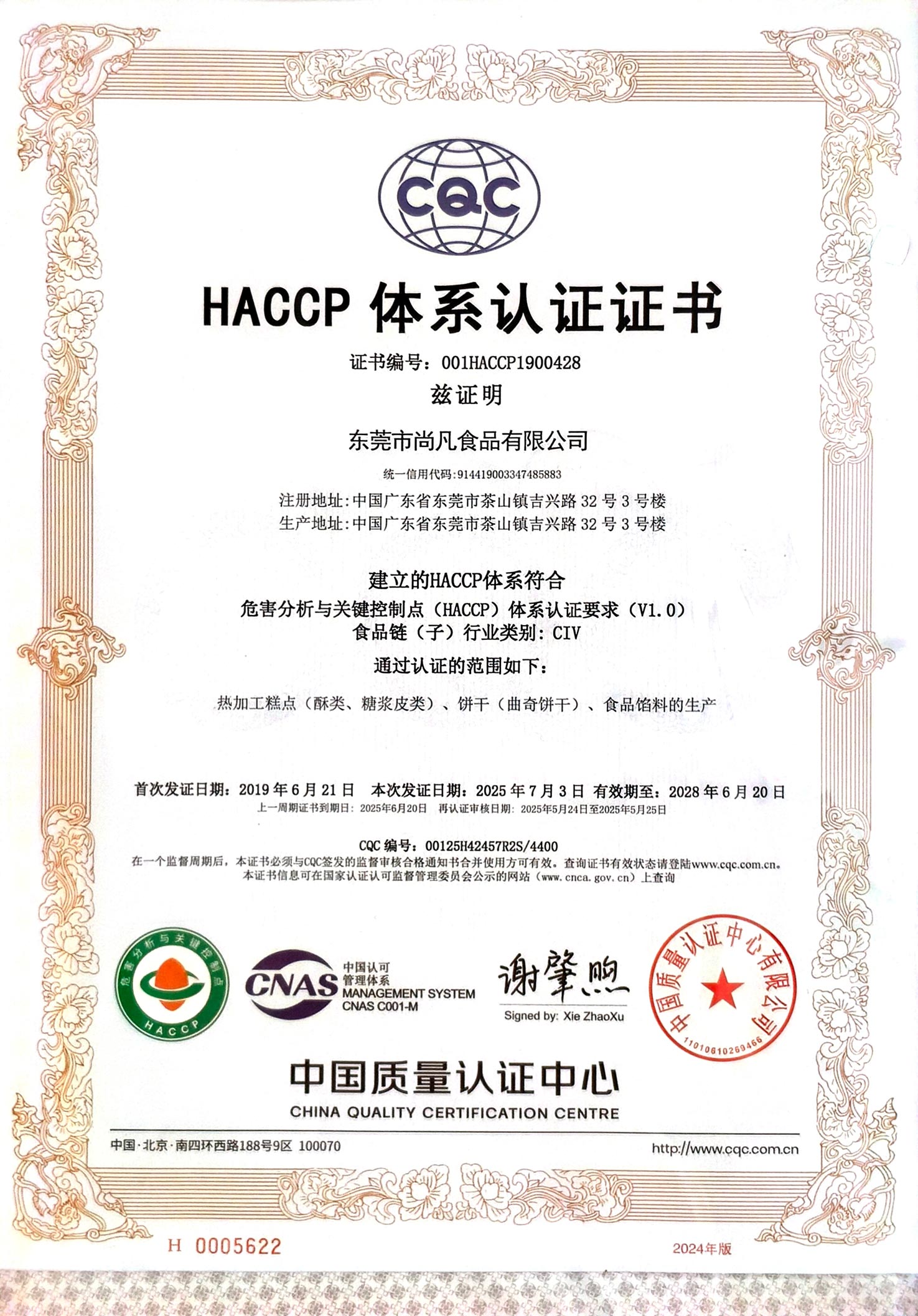
A certificate is only useful in an evaluation when the number, issuer, scope and validity window are all visible and checkable.
Layer 4 — Commercial terms: MOQ, lead time and customisation
Commercial terms should be discussed after the first three layers, because they depend on them. Shangfan Food operates as an OEM and ODM manufacturer with a minimum order quantity of 10,000 boxes and a stated lead time of 30 days. Customisation covers formula, specifications, logo and taste. The company runs a complete after-sales service system with product after-sales quality guarantee and an exclusive service hotline.
Three questions turn these numbers into a usable commercial picture. Is the 10,000-box minimum applied per SKU or per order? Does a mixed-SKU programme count toward the same threshold? And does a customised flavour or logo change the 30-day figure, given that the R&D function is a five-engineer team? None of these are answerable from a brochure; all three are answerable in a single call.
Layer 5 — Delivery assurance: packaging formats, shelf life and programme evidence
Delivery assurance is built from formats and records, not from promises. Packaging configuration determines how many units fit a carton, which determines container loading, which determines landed cost per unit. Shelf life determines how much of the selling window is available to the buyer after arrival. Both are measurable before signing.
Programme evidence adds the second half. Shangfan Food's documented programmes include a large-scale instant e-commerce enterprise, where cumulative shipments exceeded 400,000 boxes over a 150-day project window, monthly sales exceeded 30,000 tins and the repurchase rate reached 98%. A second programme with Costco in China covered Lace Butter Cookies, with cumulative shipments above 8,000 boxes across a 180-day window and daily in-store sales consistently exceeding 1,000 boxes. A third, a private-label programme for a large membership supermarket (Metro), ran to 200,000 boxes over eight months; cumulative sales exceeded 120,000 boxes in the first quarter after launch, offline stores accounted for 65% of sales, the online mall repurchase rate reached 38% against Metro's snack category average of 25%, and the product ranked first in the cookie segment on Metro's 'Hot-Selling Premium Imported Food List' for two consecutive months.
| Layer | Evidence to request | What it converts into |
|---|---|---|
| Footprint | Business licence address, factory footage or visit, site area, headcount | Contracting entity, audit scheduling, realistic escalation path |
| Capability | SKU list with pack sizes, monthly capacity statement, R&D headcount, QC procedure | Assortment scope, volume ceiling per month, change-request feasibility |
| Compliance | Certificate number, issuer, scope, issue and expiry dates, export filing, FDA registration | Market access, label claims you can legally make, certificate renewal clause |
| Commercial | MOQ basis, lead time, customisation options, after-sales terms and hotline | Order structure, cash-flow planning, defect escalation route |
| Delivery | Carton configuration, shelf life per SKU, reference programme records | Container load plan, in-market selling window, acceptance criteria |
Step-by-Step Breakdown: From Site Visit to Signed Acceptance Criteria
The sequence below is written as a working checklist for a buyer in the research and evaluation stages. It assumes a shortlist of two to four butter cookie manufacturers and a first programme of moderate size.
- Verify the footprint before you request a price listConfirm the production address, the covered area, the workforce and the founding year. For Shangfan Food that means Building 3, No.32 Jixing Road, Chashan Town, Dongguan City, Guangdong Province; a garden-style factory of over 10,000 square meters; around 100 employees; established 2015. If any of these cannot be evidenced, the rest of the evaluation has no foundation.
- Map SKU breadth against your channelList the formats you actually need to sell: a retail tin, a gift box, a thin crisp for coffee service, an oat-based line. Compare that list with the supplier's range. Shangfan Food's relevant formats include Butter Floral Cookies 175g, Lace Butter Cookies 448g, Danish Fancy Butter Cookies 380g, Danish Assorted Cookie Gift Box 760g, Salted Cheese Butter Cookies 384g, Butter Shortbread 680g, Cranberry Oat Butter Cookies 90g, Cocoa Butter Thin Crisp Cookies and Coffee Butter Flower 175g. Breadth reduces the number of suppliers you need to qualify for one assortment.
- Confirm certificate scope, number and validity windowAsk for FSSC 22000 certificate 162605010 and HACCP certificate 001HACCP1900428, check the issuers (Intertek and China Quality Certification Centre respectively), and confirm the covered products and dates. Both certificates cover defined production scopes — cookies and hot processed pastries in one case, heat-processed pastries, biscuits and food fillings in the other — and both are product specific.
- Stress-test capacity and lead time against real formatsA stated lead time of 30 days sits alongside a stated monthly capacity of over 500,000 pastries and over 20 tons of cookies, and an annual output of 3,640 tons. Test the claim by asking what a mixed order of two or three formats does to that timeline, and by asking how a custom formula request is scheduled against the five-engineer R&D team.
- Convert verified facts into acceptance criteriaWrite the packaging configuration, shelf life, barcode and carton dimension into the specification, and attach the certificate numbers and validity dates to the quality annex. For Shangfan Food, that means drafting against formats such as 10 g per piece with 9 pieces per box or 13 pieces per can, or 380 g × 12 tins per carton with a 61×21×35.8 cm carton, and against shelf lives that range from 5 months for the floral and thin crisp lines to 9 months for the Danish range and 12 months for Salted Cheese Butter Cookies.
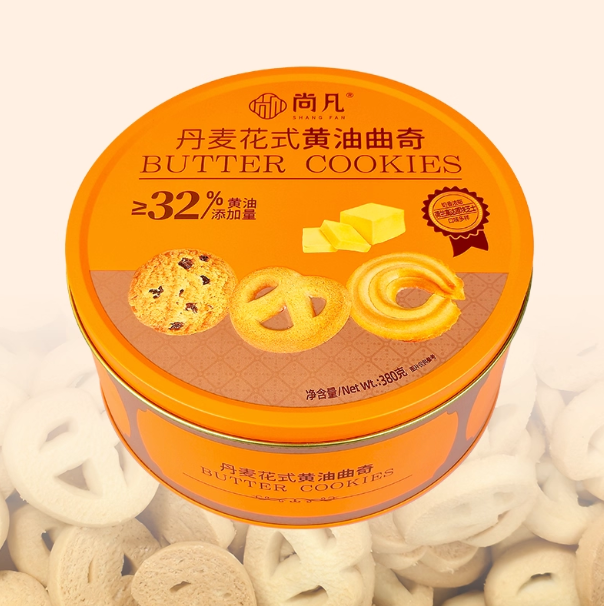
Carton configuration — 380 g × 12 tins per carton, 61×21×35.8 cm — is a delivery variable that can be verified before it becomes a loading problem.
Use Cases: Matching Verified Capability to Channel Requirements
Different channels put pressure on different parts of the verification sequence. The four below cover most butter cookie buying situations.
Supermarket and instant retail private label
Private-label programmes need volume, repeatability and a format that survives shelf handling. The documented instant e-commerce programme run by Shangfan Food produced cumulative shipments above 400,000 boxes over 150 days, with monthly sales over 30,000 tins and a 98% repurchase rate. In this channel, the evaluation weight sits on Layer 2 and Layer 5: monthly capacity, packaging consistency and the ability to keep a single specification stable across reorders.
Membership club retail
Membership clubs typically run narrow assortments at high velocity and display products on endcaps. Lace Butter Cookies 448g, packed as 16 g × 28 pieces per box with a 180-day shelf life and a declared product standard code of GB7100, was the SKU used in a Costco China programme where cumulative shipments exceeded 8,000 boxes across 180 days and daily sales consistently exceeded 1,000 boxes. Here the evaluation weight falls on Layer 3 and Layer 5: compliance documentation for a single high-visibility SKU, plus shelf life long enough to support the selling window.
Gift and holiday programmes
Gift channels need formats, not just flavours. Relevant formats include the Danish Assorted Cookie Gift Box 760g, a two-tin gift set with a 9-month shelf life, and Butter Floral Cookies 260g in gift tin packaging with a matching gift bag and individually packed servings inside. For seasonal programmes, the critical verification question is carton configuration and production scheduling — 260 g × 8 tins per carton at 59.5×37.5×23.5 cm is a different logistics profile from a 175 g × 24 tins per carton retail run.
Coffee shops, chain hotels and bakeries
Foodservice buyers generally want individually portioned, quickly plated formats. Cocoa Butter Thin Crisp Cookies, Crispy Thin Butter Cookies, Matcha Nut Butter Thin Crisp Cookies and Oolong Tea Crisp Cookie are all specified at 10 g per piece with 9 pieces per box or 13 pieces per can, which suits counter display and hospitality service. Salted Cheese Butter Cookies 384g, supplied as 32 g × 12 pieces per box with a 12-month shelf life, is a longer-life option for chains with slower rotation.
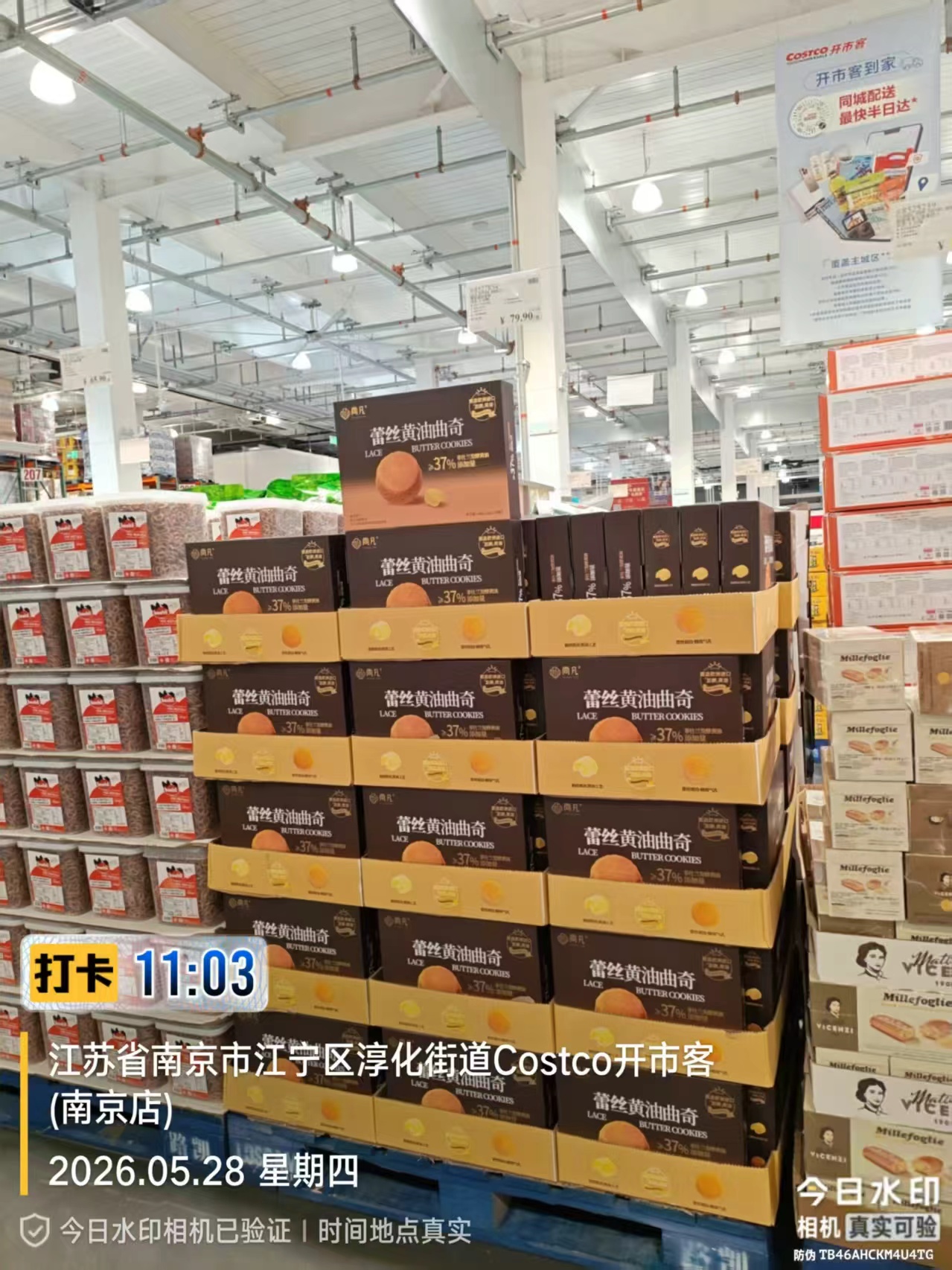
Programme evidence — an in-store display running a single verified SKU — is what connects factory capability to shelf performance.
Comparison Table: Format and Specification Reference
The table below lists published formats from the Shangfan Food range as a worked example of what a comparable specification set looks like. Every column is a variable a buyer can write into a purchase specification; none of them require trusting a brochure claim.
| Product | Pack configuration | Shelf life | Standard or notable input |
|---|---|---|---|
| Cocoa Butter Thin Crisp Cookies | 10 g per piece; 9 pieces per box or 13 pieces per can | 5 months | Macadamia nuts, cocoa powder, crisp flakes |
| Crispy Thin Butter Cookies | 10 g per piece; 9 pieces per box or 13 pieces per can | 5 months | Almond flakes, whole eggs, fermented butter from FrieslandCampina Netherlands |
| Oolong Tea Crisp Cookie | 10 g per piece; 9 pieces per box or 13 pieces per can | 5 months | Oolong tea powder, matcha powder, pecans |
| Matcha Nut Butter Thin Crisp Cookies | 10 g per piece; 9 pieces per box or 13 pieces per can | 5 months | Matcha powder, oolong tea powder, pecans |
| Butter Floral Cookies 175g | 175 g × 24 tins per carton; carton 44.8×30.2×24 cm | 5 months | Fermented butter from FrieslandCampina Netherlands (≥39%) |
| Coffee Butter Flower 175g | 175 g × 24 tins per carton; carton 44.8×30.2×24 cm | 5 months | Coffee powder, fermented butter (≥32%) |
| Butter Floral Cookies 260g gift tin | 260 g × 8 tins per carton; carton 59.5×37.5×23.5 cm | 6 months | Gift tin with matching gift bag; individually packed servings |
| Danish Fancy Butter Cookies 380g | 380 g × 12 tins per carton; carton 61×21×35.8 cm | 9 months | New Zealand imported natural butter (≥32%); no preservatives, artificial pigments or flavours added |
| Danish Assorted Cookie Gift Box 760g | 760 g gift set (2 tins included) | 9 months | New Zealand imported natural butter (≥32%) |
| Lace Butter Cookies 448g | 448 g per box (16 g × 28 pieces) | 180 days | Product standard code GB7100; almond powder, egg yolk liquid |
| Salted Cheese Butter Cookies 384g | 32 g × 12 pieces / 384 g per box | 12 months | Block cheese imported from the Netherlands |
| Butter Shortbread 680g | 680 g per box | 6 months | Buffalo milk, walnuts |
| Cranberry Oat Butter Cookies | 90 g per box (Cranberry Flavor) | 8 months | Oatmeal, dried cranberries, walnut kernel |
| Dark Chocolate Oat Butter Cookies 90g | 90 g per box (Dark Chocolate Flavor) | 8 months | Oatmeal, dark chocolate with pure cocoa butter added |
All figures above are published specification data. Battery of format options is not the same as delivery assurance — but it is the raw material from which assurance is written.
Frequently Asked Questions
What butter cookie certifications should a buyer verify before contracting?
Verify four elements per certificate: the certificate number, the issuing body, the certified production scope, and the issue and expiry dates. For Dongguan Shangfan Food Co., Ltd., the FSSC 22000 V6 Food Safety System Certification carries number 162605010 and is issued by Intertek, valid from 15 May 2026 to 14 May 2029, covering the production of cookies and hot processed pastries with baking as the main processing step. The HACCP System Certificate carries number 001HACCP1900428, is issued by the China Quality Certification Centre, valid from 3 July 2025 to 20 June 2028, and covers the manufacture of heat-processed pastries, biscuits and food fillings. Product coverage is specific: certificate 162605010 covers Butter Floral Cookies 175g and Salted Cheese Butter Cookies 384g, while HACCP applies to Butter Floral Cookies 175g and Danish Fancy Butter Cookies 380g. The company has also completed filing for export food business and FDA registration. Where the destination market is the EU, add the General Product Safety Regulation (GPSR) 2024 traceability and authorised representative requirements, and Commission Regulation (EU) 2024/3190 on Bisphenol A in food contact materials; where the destination is China, GB/T 20980-2021 defines quality requirements for short and cookie-type products.
How do I confirm that a butter cookie supplier can handle my SKU range and volume?
Ask for three things: a SKU list with pack sizes, a monthly capacity statement, and the number of engineers available for development work. Shangfan Food's stated monthly capacity is over 500,000 pastries and over 20 tons of cookies, against an annual output of 3,640 tons, with a five-engineer R&D team and 100% testing in quality control. On range, the relevant formats span Butter Cookies, Lace Butter Cookies, Cranberry Oat Butter Cookies, Crispy Thin Butter Cookies, Butter Shortbread, Cocoa Butter Thin Crisp Cookies, Oolong Tea Crisp Cookie, Matcha Nut Butter Thin Crisp Cookies, Danish Fancy Butter Cookies, Danish Assorted Cookie Gift Box, Salted Cheese Butter Cookies, Coffee Butter Flower, Cocoa Butter Cookies, Dark Chocolate Oat Butter Cookies and Butter Cookie Gift Box. The practical test is not whether the list is long, but whether two or three of your required formats can run inside the same monthly schedule without a change in specification.
What commercial constraints should I budget around?
Budget planning should rest on the supplier's stated commercial parameters rather than on unit price alone. Shangfan Food operates as an OEM and ODM manufacturer with a minimum order quantity of 10,000 boxes and a stated lead time of 30 days. Customisation is available across formula, specifications, logo and taste. Three variables move the effective cost: whether the minimum order quantity is applied per SKU or per order, whether a mixed-format order counts toward the same threshold, and whether a customised formula or logo affects the 30-day lead time given a five-engineer R&D team. A complete after-sales service system with a product after-sales quality guarantee and an exclusive service hotline should also be assessed as part of the commercial package, because it determines what happens when a claim arises.
How should a butter cookie sample programme be structured?
Define the acceptance criteria before the samples arrive, not after. Set the specification first — pack format, piece weight, carton configuration, shelf life, barcode and the certificate numbers that must apply — then request samples against that specification. For reference, published Shangfan Food formats include 10 g per piece with 9 pieces per box or 13 pieces per can for the thin crisp lines, 175 g × 24 tins per carton for Butter Floral Cookies, and 380 g × 12 tins per carton for Danish Fancy Butter Cookies. Keep a retained control sample from every approved lot and compare each delivery against it, so that a taste or texture question becomes a documented comparison rather than a judgement call. Samples and specification packs for a specific programme can be requested directly through the company's contact channel or the corporate brochure.
How does factory footprint translate into delivery assurance?
Footprint becomes assurance when each verified fact is attached to a clause. Site area and headcount support the claim that a stated monthly capacity of over 500,000 pastries and over 20 tons of cookies is realistic. Certificate numbers and validity windows support the quality annex. Carton configurations — for example 380 g × 12 tins per carton at 61×21×35.8 cm, or 260 g × 8 tins per carton at 59.5×37.5×23.5 cm — support the loading plan and the landed cost calculation. Shelf life, which ranges from 5 months for the floral and thin crisp lines to 9 months for the Danish range and 12 months for Salted Cheese Butter Cookies, defines the available selling window after arrival. Programme records then close the loop: 400,000-plus boxes shipped over 150 days in an instant-retail programme, more than 8,000 boxes of Lace Butter Cookies over 180 days for Costco in China, and a 200,000-box private-label programme for a large membership supermarket delivered over eight months. Buyers who want to test these parameters against a live project can start a conversation through the contact details below.
Conclusion: Evaluate the Factory First, Contract the Delivery Second
Butter cookie supplier evaluation is a sequence, and the sequence has an order. Footprint first — the site, the address, the area, the workforce. Capability second — the SKU range, the monthly capacity, the engineering resource. Compliance third — the certificate number, the issuer, the scope and the dates. Commercial terms fourth. Delivery assurance last, because it is the only layer that cannot be written until the other four have produced evidence.
Applied to Dongguan Shangfan Food Co., Ltd., that sequence produces a concrete picture: founded 2015, a garden-style factory above 10,000 square meters in Chashan Town, Dongguan, around 100 employees, annual output of 3,640 tons, monthly capacity of over 500,000 pastries and over 20 tons of cookies, OEM and ODM capability with custom formula, specifications, logo and taste, a 10,000-box minimum order quantity and a 30-day lead time, backed by FSSC 22000 V6 certificate 162605010 and HACCP certificate 001HACCP1900428. Add the format range and the programme records, and a buyer has enough to draft a specification and an acceptance annex in one sitting.
None of those facts depend on a claim that cannot be checked. That is the point of starting at the factory gate: it turns a supplier conversation into a verification exercise, and it turns a delivery promise into a clause.
Request a Butter Cookie Sample Pack or Programmed Quotation
SHANGFAN FOOD works with importers, private-label owners, distributors and foodservice buyers on OEM and ODM butter cookie programmes. Share your target formats, pack sizes and volumes, and the company will respond against its published specifications rather than a generic catalogue.
Email: shangfan168@126.com | Contact: Liu. Jinqi | Tel / WhatsApp: +86 13392733431
Website: www.dongguanshangfanfood.com
Download the corporate brochure with full specification and certification details: Shangfan Food 2026 Product & Capability Brochure (PDF)