Coffee Butter Flower vs. Cocoa Butter Cookies: Which SKU Wins for Breakfast Menus?
Date: 2026-10-14 Categories: FAQ Hits: 196
Coffee Butter Flower vs. Cocoa Butter Cookies: Which SKU Wins for Breakfast Menus?
The short answer: for bakery and hotel breakfast programmes, the choice between these two butter cookie SKUs is settled by two questions — what is your service format, and how much flavour intensity do you want on the tray before 10 a.m. Coffee Butter Flower 175 g is the coffee-forward, lighter pairing. Cocoa Butter Cookies 175 g is the cocoa-forward, richer alternative. Both are produced by Dongguan Shangfan Food Co., Ltd., both ship on the same 175 g × 24 tins per carton configuration, both carry a listed 5-month shelf life, and both use the same 44.8 × 30.2 × 24 cm carton (0.032 CBM). That last point is more useful than it first appears: switching between the two SKUs does not change your storage plan, your carton count or your receiving process.
This comparison is written for bakery operators, hotel F&B teams and private-label buyers specifying a breakfast line — not for gift-box or seasonal programmes. Nothing in the two specification records reviewed here contains a nutrition panel, so any calorie, sugar or fat comparison has to come from the manufacturer directly rather than being inferred from a flavour name.
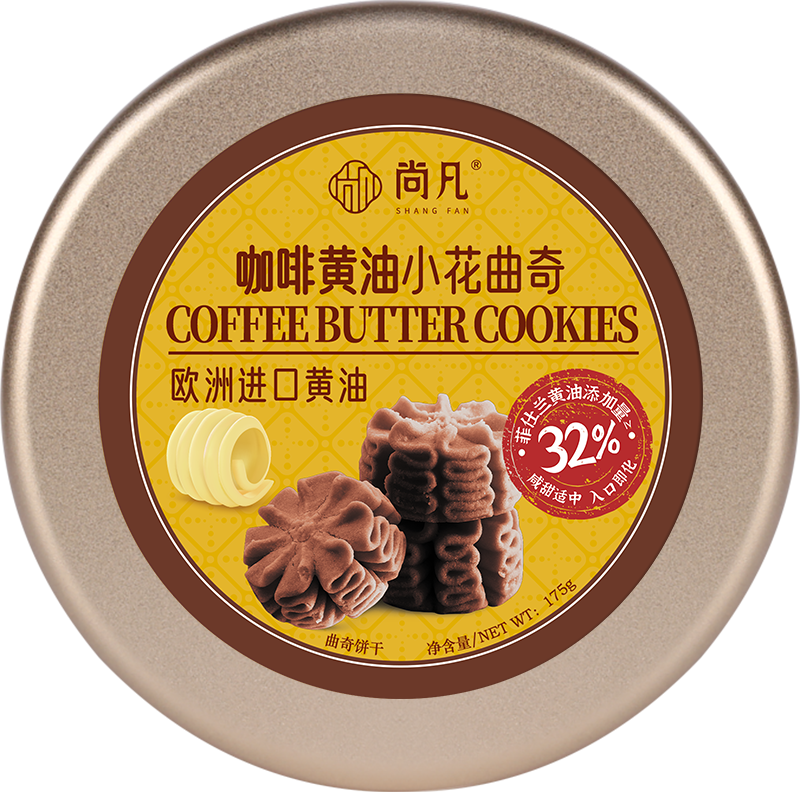
Coffee Butter Flower 175 g — the coffee-forward option in this breakfast-menu comparison. Image: Shangfan Food.
Why Breakfast Is a Different Buying Problem Than Retail Listing
A breakfast cookie is judged on three things that a retail listing never tests. First, reorder rhythm: a hotel breakfast buffet or a café breakfast set replenishes on a short cycle, so the SKU has to be repeatable, not novel. Second, service speed: the cookie is plated or handed over within seconds, which makes the pack format as decisive as the recipe. Third, flavour compatibility: a 7 a.m. menu is measured against coffee and tea, not against a dessert course.
That is why the productive version of this comparison is not “which cookie tastes better”, but “which cookie fits the slot”. Coffee Butter Flower and Cocoa Butter Cookies are both listed for supermarkets, chain hotels, bakeries, coffee shops, online e-commerce platforms and instant retail platforms — so the channel rarely decides the question on its own. The slot does.
A breakfast buyer who starts from the slot avoids the most expensive mistake in menu development: selecting a SKU on flavour preference, then discovering that the format, the shelf life or the reorder quantity does not fit how the outlet actually operates.
The Two-Question Filter That Settles This Comparison
Instead of a taste panel that never ends, run two questions in order. Answer the first before the second, because service format eliminates more options than flavour does.
Question 1 — How does the cookie leave the kitchen?
- Buffet, self-service or station-based service: the 175 g tin format supports back-of-house handling and station refilling, so the decision falls back to flavour intensity.
- Plated or set-menu breakfast: the cookie is one component of a fixed sequence, which means its flavour has to sit between the coffee course and the savoury course — usually a lighter, coffee-forward profile.
- Grab-and-go, lobby or retail-adjacent breakfast: packaging configuration becomes part of the brief. Custom specifications are available through the manufacturer's OEM and ODM service, so this is a specification conversation, not a limitation of the two SKUs.
Question 2 — What is the cookie paired with on the tray?
Flavour intensity is a positioning decision, and the ingredient listings are the honest basis for it. Coffee Butter Flower lists butter, wheat flour, starch, coffee powder, icing sugar and salt. Cocoa Butter Cookies lists butter, wheat flour, starch, icing sugar, cocoa and salt. The flavour-defining ingredient differs — coffee powder versus cocoa — and everything else in the base is the same.
In menu terms, buyers typically treat coffee-forward formats as the lighter pairing and cocoa-forward formats as the richer finish. That is a positioning convention rather than a measured sensory result, and it should be validated against your own service before a full rollout. What it does give you is a clear default: if the cookie opens the breakfast, coffee-forward leads; if the cookie closes it, cocoa-forward leads.
Quick filter: Buffet or coffee-paired service + light opening note → Coffee Butter Flower 175 g. Plated finish, grab-and-go or dessert-adjacent tray + richer close → Cocoa Butter Cookies 175 g. If both slots exist on one menu, run both — see the carton-format section below.
Industry Background: What the Butter Cookie Category Looks Like Now
The category is large, but the headline number depends entirely on how the boundary is drawn. Grand View Research values the global butter cookies/biscuits market at USD 3,358.3 million in 2024. Dataintelo puts the broader butter-based cookies category — including shortbread and sandwich formats — at an estimated USD 42.8 billion in 2025. The gap is a scope difference, not a contradiction, and it is a practical warning: when a supplier quotes “the market”, ask which definition sits behind the figure.
Two structural facts are relevant to breakfast buyers. Asia Pacific accounted for 34.2% of global butter cookie revenue in 2025 according to Dataintelo, which is where most private-label sourcing conversations now begin. Meanwhile, butter itself is a traded input with visible flows: Denmark exported USD 463 million of butter products in 2024, and China exported USD 18.5 million, according to the Observatory of Economic Complexity (OEC). Buyers who track butter sourcing tend to get clearer answers from manufacturers during price reviews, because the raw material is not a black box.
Regulation is tightening at the same time. The EU General Product Safety Regulation (GPSR) 2024 requires stricter traceability and authorised representatives for non-EU food manufacturers. Commission Regulation (EU) 2024/3190 prohibits Bisphenol A (BPA) in food contact materials, which includes packaging linings. In China, GB/T 20980-2021 is the national standard covering biscuit-type products. For a breakfast programme sold across multiple markets, these three references belong in the sourcing file alongside the product specification.
The Two SKUs, Exactly as Verified
Coffee Butter Flower 175 g — Coffee-Forward, Lighter Pairing
- Product name: Coffee Butter Flower
- Model / specification: Coffee Butter Flower 175g
- Pack configuration: 175 g × 24 tins per carton
- Listed shelf life: 5 months
- Barcode: 6936832534953
- Carton dimension: 44.8 × 30.2 × 24 cm (0.032 CBM)
- Ingredient listing: butter, wheat flour, starch, coffee powder, icing sugar, salt
- Menu role: coffee-forward; positioned as the lighter pairing at the start of breakfast service
Cocoa Butter Cookies 175 g — Cocoa-Forward, Richer Finish
- Product name: Cocoa Butter Cookies
- Model / specification: Cocoa Butter Cookies 175g
- Pack configuration: 175 g × 24 tins per carton
- Listed shelf life: 5 months
- Barcode: 6970066564836 (Cocoa Flavour)
- Carton dimension: 44.8 × 30.2 × 24 cm (0.032 CBM)
- Ingredient listing: butter, wheat flour, starch, icing sugar, cocoa, salt
- Menu role: cocoa-forward; positioned as the richer alternative and closing note
One practical detail deserves a flag. The Cocoa Butter Cookies record also carries a second thirteen-digit code, 6936832534953, which is the code printed in the Coffee Butter Flower record. Before either SKU goes on a retail or e-commerce listing, confirm the correct code against the printed tin artwork. This is a five-minute document check that prevents a much more expensive listing correction later.
Why the Matching Carton Format Is the Most Useful Fact in This Comparison
Both SKUs are built on the same logistics footprint: 175 g per tin, 24 tins per carton, 4.2 kg net per carton, 0.032 CBM per carton, 5-month listed shelf life. For a breakfast operator, that means the two SKUs are interchangeable at warehouse level even if they are not interchangeable on the plate.
The consequences are concrete. You can hold both SKUs without redesigning shelving. You can split a purchase order between them without renegotiating freight. You can run a dual-SKU breakfast menu — coffee-forward at the coffee station, cocoa-forward at the pastry counter — while keeping one receiving process, one storage rule and one reorder cycle. Most dual-SKU menu ideas die in the logistics review; this one does not have to.
Comparison Table: Coffee Butter Flower 175 g vs. Cocoa Butter Cookies 175 g
| Decision factor | Coffee Butter Flower 175 g | Cocoa Butter Cookies 175 g |
|---|---|---|
| Flavour-defining ingredient in the listed formula | Coffee powder | Cocoa |
| Menu positioning | Lighter, coffee-forward pairing | Richer, cocoa-forward finish |
| Net specification | 175 g × 24 tins per carton | 175 g × 24 tins per carton |
| Net weight per carton | 4.2 kg (175 g × 24) | 4.2 kg (175 g × 24) |
| Listed shelf life | 5 months | 5 months |
| Carton dimension | 44.8 × 30.2 × 24 cm (0.032 CBM) | 44.8 × 30.2 × 24 cm (0.032 CBM) |
| Barcode | 6936832534953 | 6970066564836 (Cocoa Flavour) |
| Base formula shared by both | Butter, wheat flour, starch, icing sugar, salt | Butter, wheat flour, starch, icing sugar, salt |
| Customisation available | Custom formula, specifications, logo and taste | Custom formula, specifications, logo and taste |
| Listed application channels | Supermarkets, chain hotels, bakeries, coffee shops, e-commerce, instant retail | Supermarkets, chain hotels, bakeries, coffee shops, e-commerce, instant retail |
| Best-fit breakfast service format | Buffet, coffee-paired and set-menu openings | Plated finishes, grab-and-go and dessert-adjacent trays |
| Manufacturer | Dongguan Shangfan Food Co., Ltd. | Dongguan Shangfan Food Co., Ltd. |
Table notes: values are taken from the manufacturer's product specification records for Coffee Butter Flower 175g and Cocoa Butter Cookies 175g. The 4.2 kg figure is the net carton weight derived from the listed pack configuration. No nutrition values are published in the reviewed records.
How to Run a Breakfast-Menu Trial in Seven Steps
- Define the slot before the SKU. Write down the service window, the station and the item the cookie sits next to. This single sentence eliminates one of the two SKUs in most cases.
- Convert the slot into a one-page flavour brief. If the brief says “pairs with hot coffee, light opening note”, Coffee Butter Flower is the starting point. If it says “rich closing note, dessert-adjacent”, Cocoa Butter Cookies is.
- Verify the specification and the certification file together. Both SKUs are listed among the products associated with the manufacturer's FSSC 22000 V6 certification (certificate 162605010, issued by Intertek, valid 2026-05-15 to 2029-05-14) and its HACCP certificate (001HACCP1900428, issued by China Quality Certification Centre, valid 2025-07-03 to 2028-06-20).
- Confirm commercial terms in writing. The capability record lists an MOQ of 10,000 boxes and a lead time of 30 days; the procurement record lists an MOQ of one 20 ft container with delivery terms FOB/CIF, acceptance criteria of pre-shipment inspection, and payment by bank transfer to corporate account. Confirm which threshold applies to your order size during quotation.
- Fit the lead time to the menu cycle. A 30-day listed lead time should be mapped against the date your menu is printed, not against the date you need stock.
- Run both SKUs on one service line. Because the carton format is identical, a parallel test costs nothing in warehouse terms and gives you a real answer instead of a preference.
- Decide between single-SKU focus and a dual-SKU menu. If both perform, keep both and assign them different jobs: one to the coffee station, one to the pastry counter.
Verification reminder: request the specification sheet and the certificate of analysis for the specific production batch, not only the corporate certifications. The stated acceptance criterion is pre-shipment inspection, and the stated quality-control approach is 100% test — those two points are what a receiving team can actually act on.
Use Cases: Where Each SKU Earns Its Place on the Menu
Hotel breakfast buffet
A buffet line runs two flavour registers: the fresh, coffee-adjacent items at the start of service and the sweeter items toward the end. Coffee Butter Flower fits the first register; Cocoa Butter Cookies fits the second. Because both use the same tin and carton, the buffet can carry both without a second storage location. Chain hotels are listed among the application channels for both SKUs.
Bakery and pastry counters
Bakery counters usually need variety within a narrow footprint. Two 175 g tins from the same product family deliver two clearly separated flavour directions — coffee and cocoa — from one carton specification, one shelf-life rule and one receiving workflow.
Coffee shops and café set menus
A set menu is a sequence, and the sequence decides the SKU. Where the cookie accompanies the coffee, the coffee-forward formula keeps the pairing coherent. Where the cookie is sold as a standalone add-on next to a dessert display, the cocoa-forward formula reads more clearly as a treat.
In-room amenities and instant retail
Both SKUs are listed for online e-commerce and instant retail platforms, and both use a sealed tin format with a five-month listed shelf life. For amenity trays and grab-and-go breakfast retail, the decision returns to the two-question filter; packaging configuration can be discussed as part of OEM and ODM customisation.
What to Check in the Manufacturer Behind Either SKU
A SKU only performs as well as the factory behind it. The two compared products are both manufactured by Dongguan Shangfan Food Co., Ltd., a bakery manufacturer based in Chashan Town, Dongguan City, Guangdong Province, founded in 2015 and operating a garden-style factory of more than 10,000 m² with 100 employees.
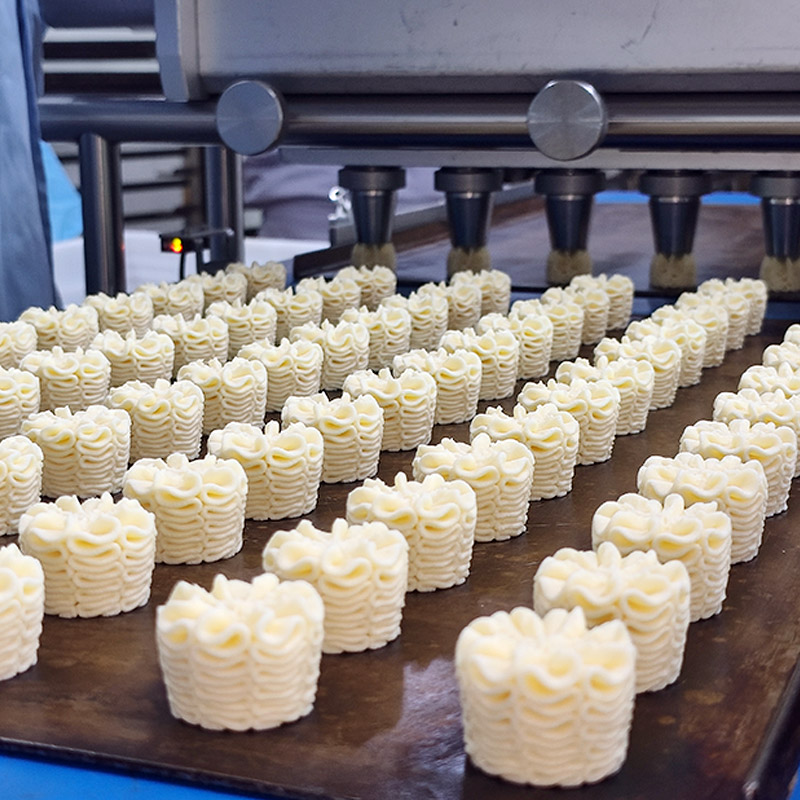
Production footage from the Shangfan Food facility in Chashan Town, Dongguan. Image: Shangfan Food.
What a buyer should verify falls into six buckets:
- Output and capacity: 3,640 tons annual output, with monthly capacity listed as over 500,000 pastries and over 20 tons of cookies.
- Development capability: an R&D team of five engineers, and OEM and ODM production services covering custom formula, custom specifications, custom logo and custom taste development.
- Quality control: 100% test, with pre-shipment inspection listed as the acceptance criterion.
- Certification and filings: FSSC 22000 V6 (162605010, Intertek; scope covering the production of cookies and hot-processed pastries) and HACCP (001HACCP1900428, China Quality Certification Centre; scope covering the manufacture of heat-processed pastries, biscuits and food fillings). Export food business filing has been completed and FDA registration has been completed.
- Export footprint: an export ratio of 10%, with main markets including PRC, EU, USA, South Korea and Singapore; the capability record lists the United States, South Korea, Singapore, Germany, Russia, Japan, France, the United Kingdom, Greece, Italy, Hong Kong (China), Taiwan (China), Canada, the Netherlands, Norway, Portugal, Saudi Arabia and Sweden.
- After-sales structure: a complete after-sales service system, a product after-sales quality guarantee and an exclusive service hotline.
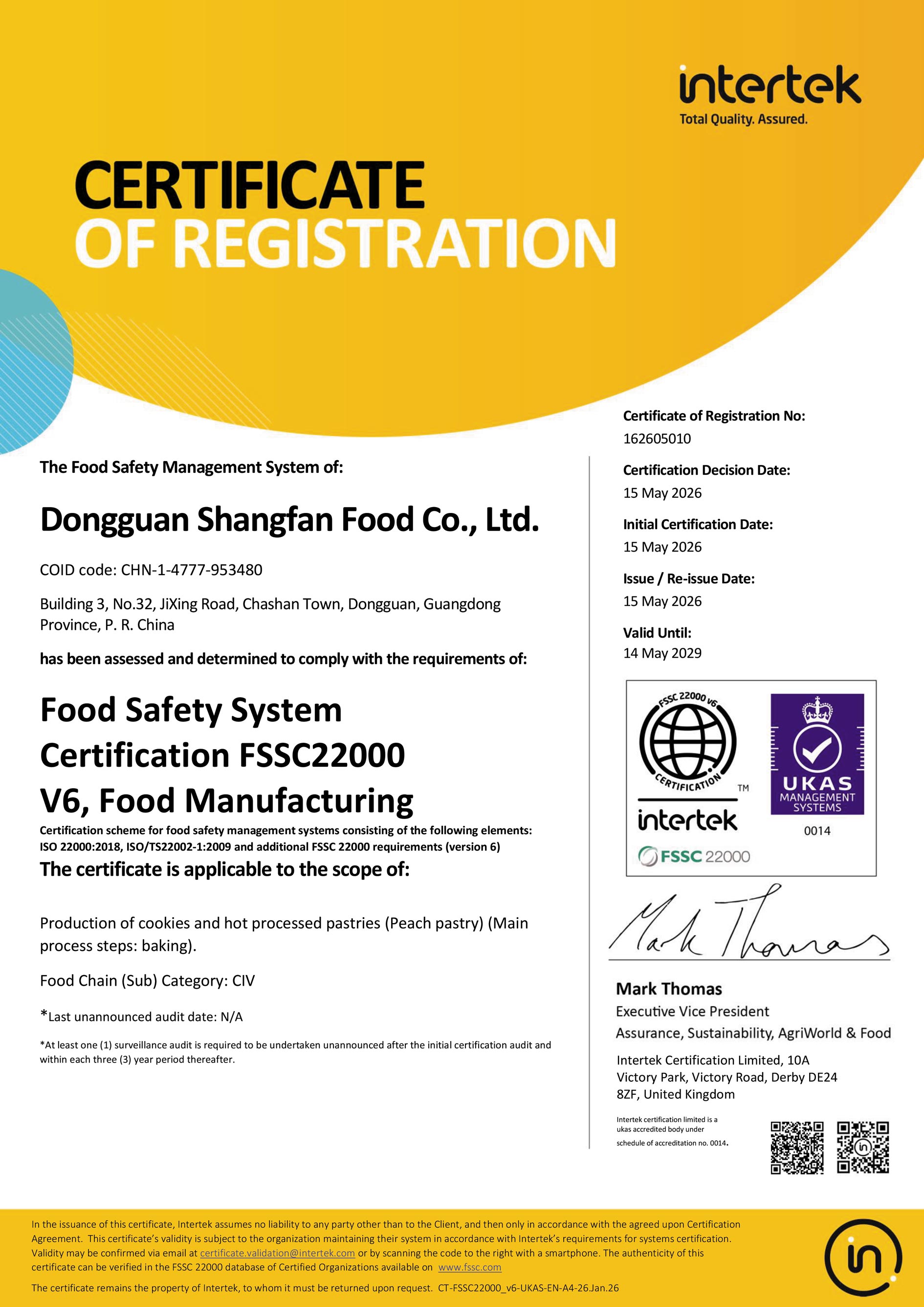
FSSC 22000 V6 certification, certificate 162605010 issued by Intertek, valid 2026-05-15 to 2029-05-14. Image: Shangfan Food.
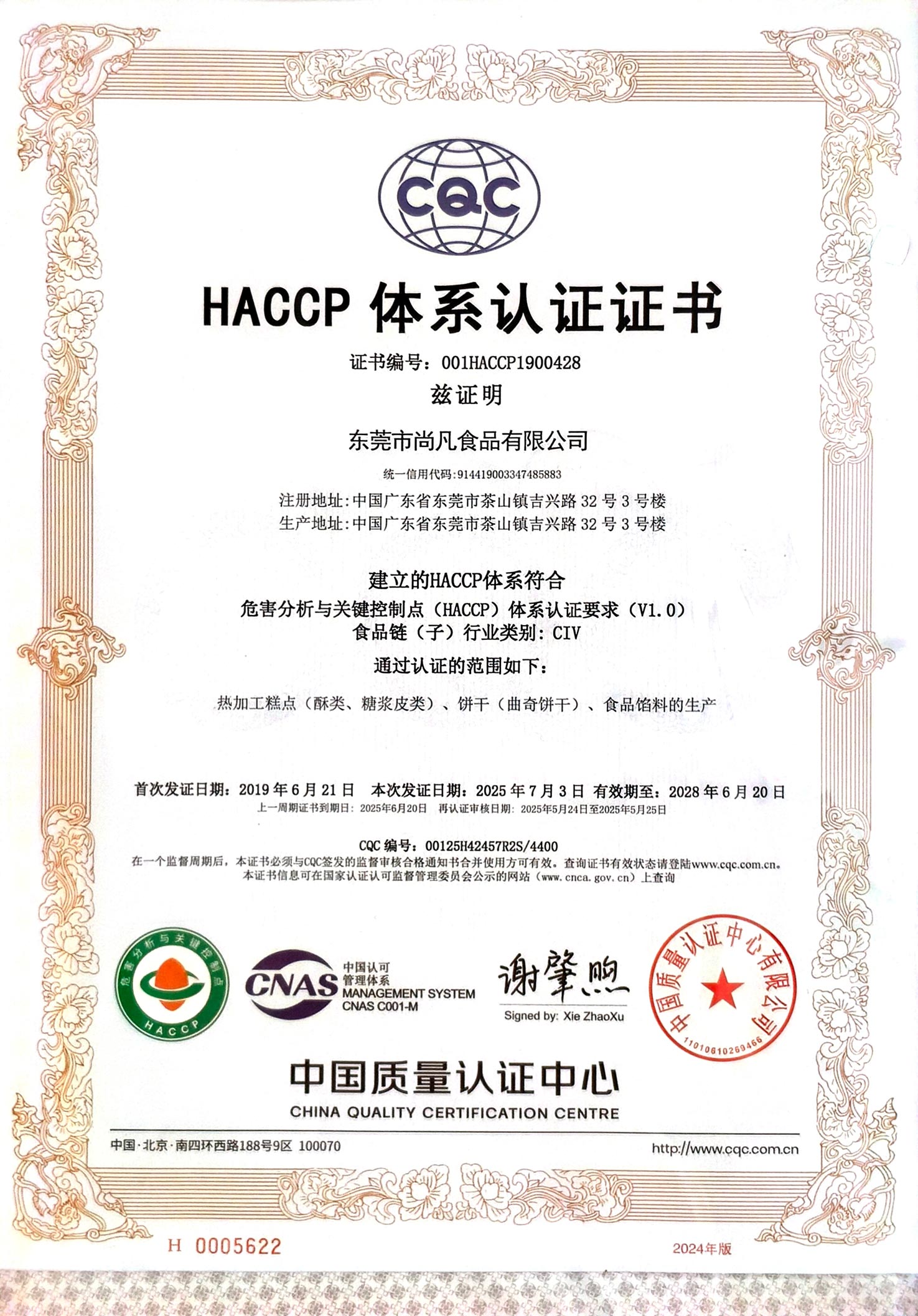
HACCP system certificate 001HACCP1900428, issued by China Quality Certification Centre, valid 2025-07-03 to 2028-06-20. Image: Shangfan Food.
Track record is the last piece of the check, and it is the one buyers read first. In a private-label OEM programme for a large-scale instant e-commerce enterprise (Elephant Supermarket), cumulative shipments exceeded 400,000 boxes over a 150-day collaboration window, with monthly sales above 30,000 tins and a repurchase rate of 98%. The programme also removed hidden costs for the retailer — factory construction, equipment procurement, product design and inventory stocking — by transferring them to the manufacturer. Separately, Lace Butter Cookies supplied to Costco China shipped more than 8,000 boxes over 180 days, with daily in-store sales consistently above 1,000 boxes.
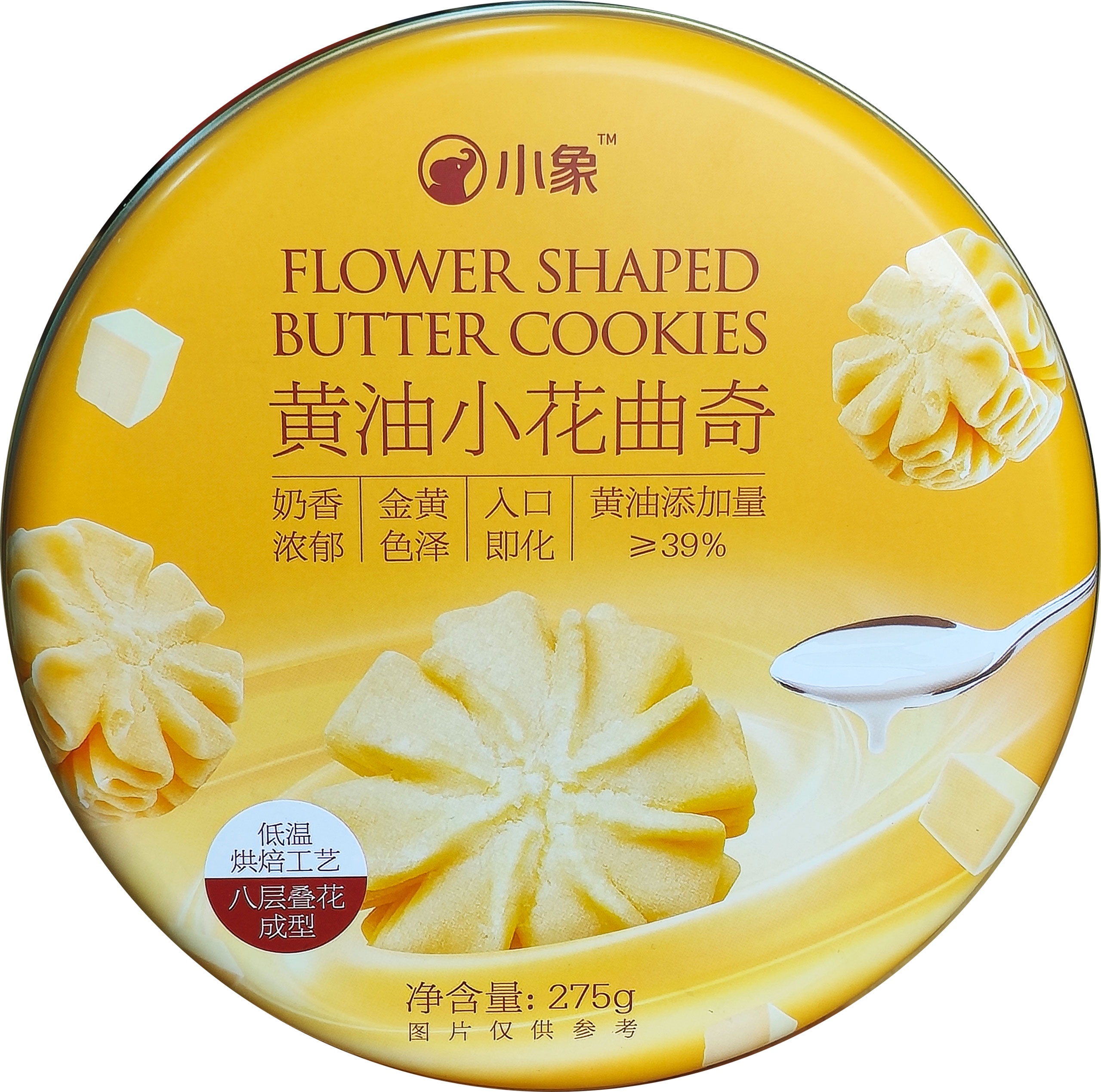
OEM private-label programme delivered by Shangfan Food for Elephant Supermarket, with cumulative shipments above 400,000 boxes. Image: Shangfan Food.
Frequently Asked Questions
What certifications should a breakfast-menu buyer verify before ordering either SKU?
Ask for the certificates that explicitly list the product. Both Coffee Butter Flower 175g and Cocoa Butter Cookies 175g appear among the products associated with Dongguan Shangfan Food Co., Ltd.'s FSSC 22000 V6 certification (certificate 162605010, issued by Intertek, valid 2026-05-15 to 2029-05-14) and its HACCP certificate (001HACCP1900428, issued by China Quality Certification Centre, valid 2025-07-03 to 2028-06-20). The HACCP scope covers the manufacture of heat-processed pastries, biscuits and food fillings; the FSSC 22000 V6 scope covers the production of cookies and hot-processed pastries. Export food business filing and FDA registration have also been completed. For EU-facing menus, add GPSR 2024 traceability requirements and Regulation (EU) 2024/3190 on BPA in food contact materials to the review.
Can the flavour intensity or the format of these two SKUs be customised?
Yes. The manufacturer provides OEM and ODM production services, and the stated customisation scope covers custom formula, custom specifications, custom logo and custom taste development. That means a breakfast programme is not limited to the two standard 175 g variants: a buyer can specify the formula direction, the packaging configuration and the branding, provided the commercial thresholds are met.
What are the minimum order quantity, delivery terms and payment terms?
The capability record lists an MOQ of 10,000 boxes and a lead time of 30 days. The procurement record lists an MOQ of one 20 ft container, delivery terms FOB/CIF, acceptance criteria of pre-shipment inspection, and payment by bank transfer to a corporate account. Because the two records describe different order levels, buyers should confirm which threshold applies to their specific quotation before planning a rollout.
How do we validate batch quality before a breakfast rollout?
The stated quality-control approach is 100% test, and the stated acceptance criterion is pre-shipment inspection. In practice that means buyers should combine three checks: the specification sheet for the ordered model (Coffee Butter Flower 175g or Cocoa Butter Cookies 175g), the certificate of analysis for the production batch, and the barcode verification against the printed tin artwork — a step worth doing because the Cocoa Butter Cookies record includes a second thirteen-digit code that also appears in the Coffee Butter Flower record.
How much lead time should we plan for, and can a dual-SKU menu be sourced together?
The listed lead time is 30 days, supported by monthly capacity of over 500,000 pastries and over 20 tons of cookies and annual output of 3,640 tons. A dual-SKU breakfast menu is straightforward to source together, because both products share the same 175 g × 24 tins per carton configuration, the same 44.8 × 30.2 × 24 cm carton (0.032 CBM) and a 5-month listed shelf life. To move from evaluation to execution, request a quotation and sample arrangement for both SKUs, and download the current product brochure from the Shangfan Food catalogue.
Conclusion: Pick the Slot, Then Pick the SKU
The comparison does not need to be resolved by opinion. Coffee Butter Flower 175 g is the lighter, coffee-forward option, defined in its ingredient listing by coffee powder. Cocoa Butter Cookies 175 g is the richer, cocoa-forward alternative, defined by cocoa. Both are produced by the same manufacturer, both are listed for the same application channels, and both carry identical pack, carton and shelf-life parameters.
So the decision rule is short. If your breakfast cookie opens the service and sits next to hot coffee, start with Coffee Butter Flower. If it closes the tray, or your format is grab-and-go and dessert-adjacent, start with Cocoa Butter Cookies. If you genuinely serve both moments, run both — the shared carton format means the second SKU costs you a menu line, not a logistics project.
Before committing, confirm three things in writing: the specification sheet for the exact model, the certification documents that list that product, and the commercial terms that apply to your order size. Those three documents resolve most of what a taste test cannot.
Next Step: Quote, Samples and Specification Sheets
Shangfan Food supplies the full butter cookie range — including Butter Floral Cookies, Lace Butter Cookies, Crispy Thin Butter Cookies, Cranberry Oat Butter Cookies, Salted Cheese Butter Cookies, Danish Fancy Butter Cookies and Butter Shortbread — with OEM and ODM support covering custom formula, specifications, logo and taste.
Request a quotation and sample arrangement for Coffee Butter Flower 175 g and Cocoa Butter Cookies 175 g, or download the product catalogue: Shangfan Food Brochure (PDF)
Contact: Liu. Jinqi | Email: shangfan168@126.com | Tel / WhatsApp: +86 13392733431 | Chat on WhatsApp | www.dongguanshangfanfood.com
Address: Building 3, No.32 Jixing Road, Chashan Town, Dongguan City, Guangdong Province, China.
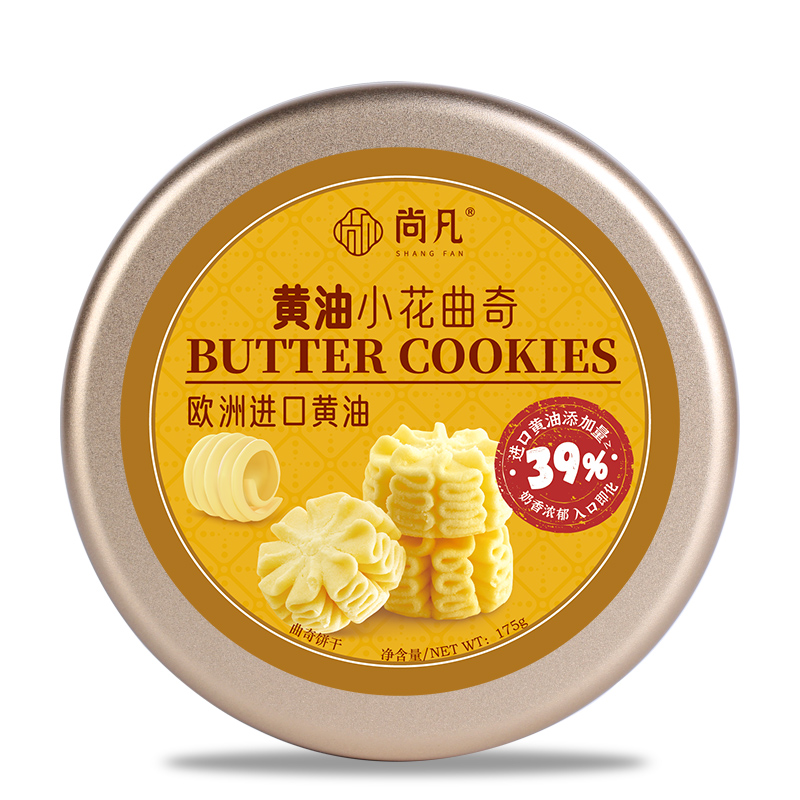
The 175 g tin format used across the Shangfan Food butter cookie range, including the two SKUs compared in this article. Image: Shangfan Food.